
Performing Daughterhood
(An)other Mothers Day.

Another (New Zealand) Mother’s Day has come and gone. It is on this day each year that I feel the most motherless.
And I cannot help but think of my adopter and what this day must mean for her. She has cut all contact with me, my daughters and my grandchildren. I can only assume it is because I asked too many questions. Because I failed to adequately perform the role of her daughter as if she were my natural mother.
As if.
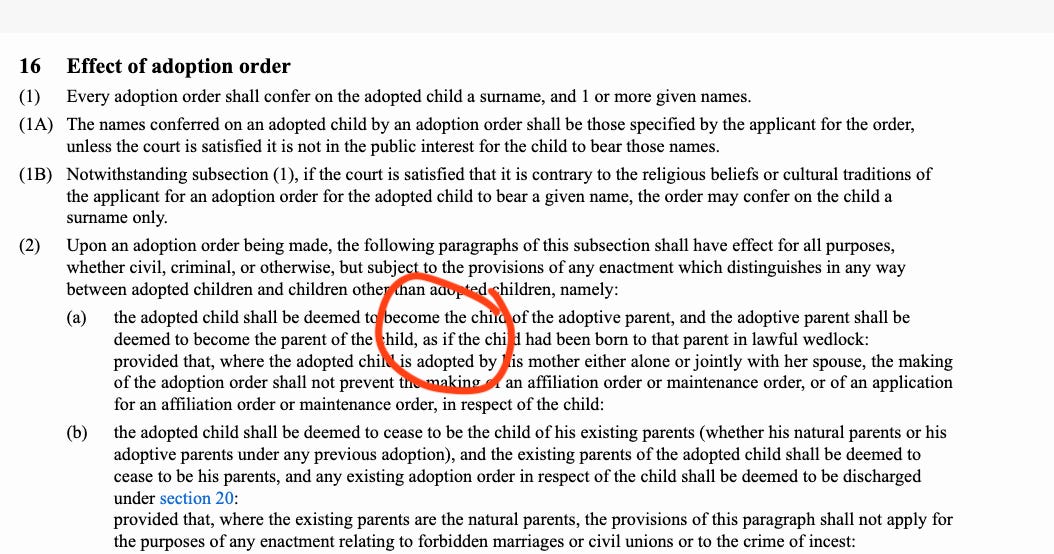
Two tiny words embedded in the very centre of New Zealand adoption law (and its equivalents across the common law world).1
The adopted child shall be treated as if born to the adopter. As if born to the random person allocated to play mother.
As if.
A two-word grenade. An entire instruction for how to live.
Those two words are not accidental. They are the fulcrum of the fiction. A person transformed into a different person by court order. A court order requiring everyone (legal, social, political, personal) in the adopted person’s life to act as though this were true.
To live as an adopted person is to be handed a script, unwritten and unspoken but transmitted through every interaction, every family photograph, or gathering, every time someone says, "you look like…" (fill in the gap), every time someone tells you you’re lucky, or your parents are the best, the script kicks in, saying - perform this:
Perform belonging. Perform the daughter. As if you were the daughter.
It is the adopted person’s job to make the legal fiction liveable. To inhabit it. To not ask questions, or at least, not too many. To become, through the daily practice of performance, someone who does not visibly carry the weight of what has been lost.
And most of us perform admirably, with considerable skill. We learn early that so much of our lives depends on how convincingly we inhabit the role. We call the adopter Mum. We absorb her wants and needs. We stand in her family photographs, tilt our faces toward her, and learn not to look too hard at strangers' faces, in case we are looking for something we are not supposed to want.
